


_ANZ-Group-shot_v2.png?w=100&v=f3a4afac-70ac-4758-8474-ff17fe163b1c&itok=Z_Qi2FlQ)


.png?w=100&v=76611618-74f9-4150-85bd-f3f88e49eece&itok=5ehAJg_Q)


.png?w=100&v=5053a26b-c336-46d9-b44e-ab91738f07c9&itok=efvsqCNL)


.png?w=100&v=d5f9955a-145e-481e-8081-5ddf4d74c7cc&itok=hKuNtBOw)


.png?w=100&v=2695a42f-b099-4e31-bdbd-c1b445ff88c0&itok=Md9-7E8t)


%20(2).png?w=100&v=a9b7928b-cece-4e51-b913-62ae316129a9&itok=fEHREjki)
_ANZ-Group-shot.png?w=100&v=72a4a24c-7670-47f7-a68e-edeaafa41c8d&itok=k25pq8iJ)
_ANZ-Group-shots.png?w=100&v=4d5e1cd2-60a9-45da-bcfb-1b8500ccaea9&itok=v6A67Pxg)


Drill into timber, soft metal and hard materials including brick and concrete with the RYOBI 18V ONE+ Hammer Drill.


RYOBI offers a wide range of cordless line trimmers with options across the 18V ONE+ and 36V systems. This guide explains what to look for and how to match the right type of line trimmer to your outdoor space.
While they might all look similar, choosing the right line trimmer can make a big difference to how quickly, comfortably and neatly you maintain your yard. Whether you’re tidying a compact courtyard, cleaning up around garden beds or tackling long grass along fence lines, the best model is the one that suits your block size, grass type, trimming habits and battery system.
Before comparing models, think about the work your line trimmer will actually do. A small lawn with light edging around paths and garden beds doesn’t need the ‘Rolls Royce’ of line trimmers. It won’t require the same power or runtime to trim a large property with long fence lines, thicker grass and rougher patches. If you trim every week or two, a lighter 18V model may be just right. If your grass is often a bit overgrown, damp or dense before you get to it, stepping up to a brushless 18V HP or 36V model can help maintain cutting performance.
RYOBI’s 18V ONE+ system is a great choice if you already own compatible power tools or want a lightweight, easy-handling trimmer for regular maintenance. The 36V range is designed for users who want more power and runtime for larger yards or tougher trimming tasks. Battery capacity also matters – higher amp-hour (Ah) batteries can extend runtime, which is useful when your edging, paths, trees, play equipment and garden beds add up to a longer trimming session. If you need even more power and runtime, HP tools and batteries may be better suited to your tasks. HP models are available in both 18V and 36V ranges.
The cutting path describes how wide the trimmer cuts with each pass. Smaller cutting paths, such as 25cm or 30cm, are easy to control in tight spaces and suit light-duty work. Wider cutting paths, such as 33cm, 38cm, 40cm or 43cm, help cover more ground and suit bigger yards. Trimmer line diameter also affects durability. Thicker line generally stands up better around hard edges such as concrete, timber, rocks and pavers, while finer line is suitable for lighter grass and everyday tidying. However, too thick line can cause extra drag and damage the line trimmer’s motor. Check your owner’s manual for the maximum diameter line your chosen line trimmer can use safely.
Comfort is especially important if trimming takes more than a few minutes. Telescopic shafts help suit different user heights, adjustable handles support better balance, and pivoting or adjustable heads can help switch between trimming and edging. Straight shaft models are useful for reaching under shrubs, benches or low branches, while lighter curved or compact designs can feel easier to manoeuvre for quick work around small lawns.
If you owned a line trimmer a long time ago, you’ll probably still remember the constant hassles (nightmares) of reloading the trimming line. Thankfully, line replenishment systems have improved a lot in recent years. Some RYOBI models include quick reload designs that can be done in around 60 seconds.
When considering how the line is fed out during operation, there are a couple of options. Auto-feed heads advance line automatically during use, which is convenient for light-duty trimming. Bump-feed heads let you release more line by tapping the head on the solid ground, offering control during heavier work.
For courtyards, townhouses, small lawns and users who mainly want neat edges after mowing, an 18V ONE+ line trimmer is a practical starting point. Models such as the RYOBI 18V ONE+ 25cm line trimmer kits and 25/30cm kits are designed to be simple to use, easy to carry and convenient to store. They are especially appealing if you already use the 18V ONE+ battery system for power tools, drills, blowers, hedge trimmers or other products.
If your lawn area is a little larger or you regularly deal with thicker grass and longer edges, an 18V HP brushless line trimmer gives you a useful performance step up while keeping the flexibility of the 18V ONE+ system (because it still uses the same batteries). Models such as RYOBI 18V ONE+ HP brushless 33/38cm line trimmers offer wider cutting paths, more efficient motors and improved control for small to medium-sized gardens. They are a strong option for home owners who need a bit more trimming capability.
For larger suburban blocks, heavier edging and users who want more sustained power, RYOBI 36V brushless line trimmers are designed to take on tougher garden maintenance. Models such as the 36V Brushless 33/38cm Line Trimmer Kit provide extra power compared with entry-level 18V models while remaining cordless and easy to start. This category suits gardeners who want dependable performance across lawns, fence lines, paths and heavier seasonal growth.
If you have long boundary lines, lots of obstacles, large lawn areas or tougher grass, a high-performance 36V HP brushless model is worth considering. Options such as the RYOBI 36V HP brushless 35/40cm line trimmer kit and 36V HP brushless Whisper™ 38/43cm kit are aimed at users who want more power, larger cutting capacity and premium features. They are well suited to serious home gardeners who need a trimmer that can keep up with bigger outdoor areas. And Whisper™ models are quieter than standard line trimmers, something you and your neighbours will appreciate.
A line trimmer is designed for grass, lawn edges, weeds and similar vegetation at ground level. If you regularly need to clear dense brush, thick woody weeds like blackberries or ferns, or rough, overgrown areas, a brushcutter with a metal blade may be a better match. RYOBI’s brushcutter options are designed for heavier cutting tasks than standard line trimmers. For most residential lawns, however, a suitable 18V or 36V line trimmer will handle regular edging, trimming and finishing work with less maintenance than petrol-powered alternatives.
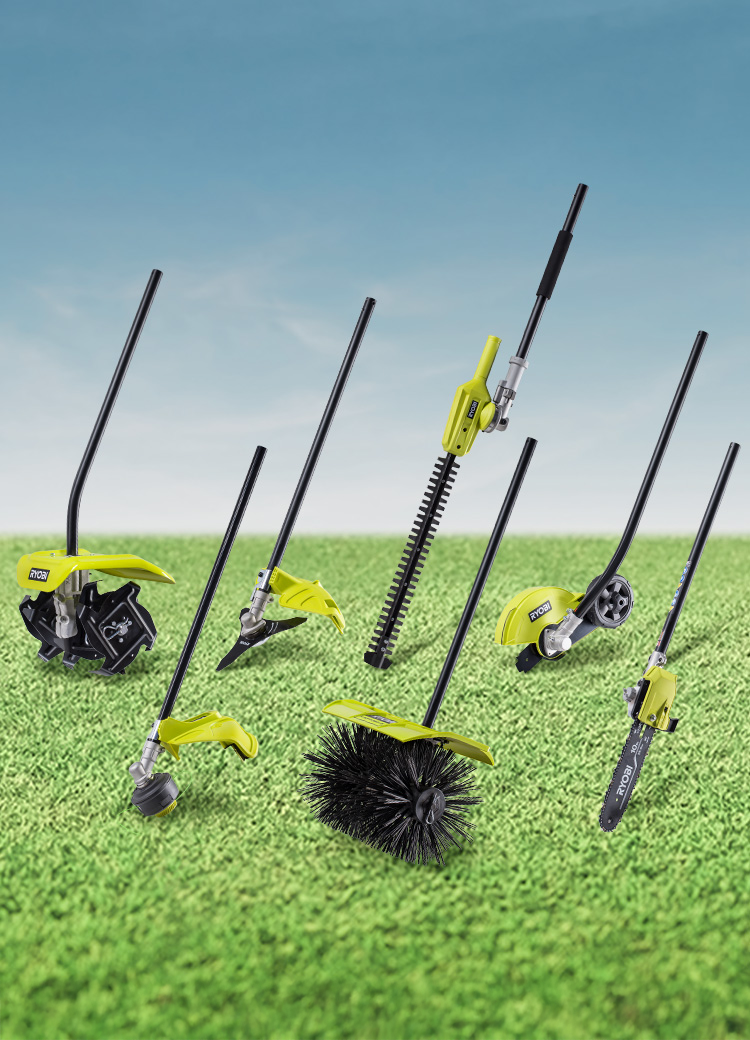
A cost-effective way to grow your power garden tool collection is with RYOBI's Expand-IT range. One power head (18V or 36V) powers a range of accessories, saving you money and space in your garden shed or garage. For instance, purchase the Expand-IT line trimmer (power head plus line trimmer attachment) in either 18V or 36V and add further attachments as you need them ie: edger, leaf blower, brushcutter, hedge trimmer, cultivator, sweeper, pruner and more.
Each attachment can be purchased separately at Bunnings.
Get started with RYOBI’s most popular line trimmers.
Not sure where to start in your search for the best line trimmer for your yard? Here is a list of some of our most popular line trimmers.
It is important to always use the correct line diameter for your model — using thicker line than specified can stress the motor and can void warranty. If the line is constantly breaking, check the age of the line (old line can become brittle and break easily) or reassess how you are using the line trimmer. Cutting thicker, woody weeds is often better suited to a brushcutter. RYOBI line trimmer line and/or replacement spools are available at Bunnings.
A line trimmer cuts grass horizontally — it trims around the edges of lawns, paths, and garden beds. It uses a spinning nylon line to cut through grass and weeds. An edger has a metal blade that spins vertically into the soil to create a clean, defined border between the lawn and a path or garden bed. RYOBI Expand-It trimmers can accept an edger attachment, giving you both functions from one tool and one battery.
A line trimmer cuts grass horizontally — it trims around the edges of lawns, paths, and garden beds. It uses a spinning nylon line to cut through grass and weeds. A brushcutter has a similar design to a line trimmer but uses metal blade for more heavy-duty cutting. It is better suited to cutting woody weeds like blackberries, ferns and thicker undergrowth. RYOBI Expand-It trimmers can accept an brushcutter attachment, giving you both functions from one tool and one battery.
Yes — a lawn mower cannot reach lawn edges along paths, fences, around garden bed borders or into tight spots. A line trimmer is the finishing tool that gives your lawn its clean, tidy edge after mowing. Whether you trim before mowing or after is a question for debate around a barbecue! Together, a mower and a trimmer handle most residential lawn maintenance tasks.
Advice to get you equipped to achieve the garden you’ve always dreamt of.
.png?w=100&v=6c04e2a3-04b9-449c-97a0-86f8df82dcb1&itok=D7d8Umfz)

.png?w=100&v=07272864-2df4-45f0-aa93-568aa3920466&itok=Lj7SSICT)

.png?w=100&v=4297d0f7-8d6a-4632-bff2-7c593a97d3cb&itok=fnsLcLhG)


.png?w=100&v=6fe76245-ac4a-4aa3-986d-04347f143028&itok=dFif4A99)


.png?crop=yes&k=c&w=690&h=690&v=c8284d19-abba-456f-ad63-dae1ca685f1f&itok=u5iHjKiR)


